Introduction: Watching the Idea Before the Numbers
The basics of the stock market are usually explained with clean diagrams. Boxes and arrows. Buyers and sellers. Demand and supply.
But that is not how I first noticed it.
I noticed it in conversations.
Someone is checking their phone during a family function. Someone casually mentioned, “The market was down today.” A news anchor speaking with unusual urgency at 9:15 in the morning. A sudden silence when prices fell sharply.
Before I understood balance sheets or market capitalization, I sensed that the stock market was less about charts and more about the behaviour of humans. It seemed like a public theatre of expectations.
Over time, as I quietly observed, the basics of the stock market began to look simple on the surface and complex underneath. Not complicated in mathematics, but layered in psychological aspects.
At its core, it is a place where ownership changes hands. But in reality, it feels like a place where beliefs change hands even faster.
Ownership: The Quiet Core of the Basics of the Stock Market
A company divides itself into shares. These shares are offered to investors. When someone buys a share, they own a small part of that company. That is the mechanical definition.
Yet the emotional meaning of ownership is different.
Owning a physical object feels tangible. Owning a fraction of a corporation exists only in digital records. It is represented by numbers on a screen—demat accounts, portfolio statements, transaction histories.
Still, something shifts when ownership is involved.
News about that company suddenly matters more. Quarterly earnings become personal. Industry developments feel relevant. Even a minor regulatory announcement look like one’s own financial state.
The basics of the stock market revolve around this invisible contract: capital in exchange for partial ownership. But ownership here is abstract. It is trust placed in management, in governance, in future performance.
And trust, I’ve noticed, is never static.
Price: A Number That Reflects Collective Mood
In theory, stock prices move based on demand and supply. Buyers bid, sellers offer, and the market discovers a price.
In practice, price feels like a mood indicator.
The basics of the stock market describe price discovery as rational. But while observing market conversations, it rarely sounds entirely rational. Words like ‘confidence’, ‘fear’, ‘optimism’, and ‘panic’ float through discussions.
A company may report stable earnings, yet its stock might fall because expectations were higher. Another may show modest growth, yet rallies because the future narrative feels promising.
Price, then, appears less like a static valuation and more like a collective opinion of investors.
Indices—Sensex, Nifty, and global benchmarks—act as broader signals. When they rise, headlines turn positive. When they fall sharply, anxiety spreads quickly.
It is curious how a fluctuation of a few percentage points could influence the emotions of so many people simultaneously.
Perhaps the basics of the stock market include this subtle truth: numbers represent narratives in motion.
Risk and Reward: Two Words Often Paired Together
Every explanation of the basics of the stock market eventually introduces the risk and return.
Higher potential returns are associated with higher risk. Lower risk often corresponds with modest returns. The equation appears neat.
Yet the lived experience of risk is uneven at different situations.
For someone new, a small fluctuation feels significant. For someone experienced, larger swings might appear routine. Context shapes perceptions.
I’ve observed that risk is rarely discussed in isolation. It is framed against time, goals, or past outcomes. A bull market makes risk appear manageable. A bear phase magnifies caution.
The basics of the stock market do not eliminate uncertainty. Companies can perform differently than expected. Economic conditions shift. Liquidity tightens or expands.
Still, participation continues.
There is something about the possibility of reward that draws attention. Not always greed—sometimes curiosity, sometimes ambition, sometimes a desire to participate in economic growth.
The risk and reward move together, like two sides of the same coin. Neither exists meaningfully without the other.
The Marketplace Structure: Exchanges and Systems
Behind every visible activity lies structure.
Stock exchanges such as the NSE and BSE provide the infrastructure. Brokers facilitate transactions. Regulators oversee compliance. Clearing corporations ensure settlement.
The basics of the stock market include this institutional backbone, though it rarely appears in everyday conversation.
Trades settle in cycles. Regulations attempt to maintain transparency. Disclosure requirements shape corporate communication. There are circuit breakers to halt extreme volatility.
It is a system designed to maintain order in a space driven by emotions.
I sometimes think about how remarkable it is that millions of transactions occur daily with relatively little friction. Shares move from one account to another in seconds. Funds are debited and credited digitally within seconds.
The complexity of the structure remains mostly invisible to the average participant in the stock market.
Perhaps that invisibility contributes to trust. Or perhaps it simply becomes background noise.
Long-Term Investors and Short-Term Traders
Within the basics of the stock market, participation styles vary.
Some individuals speak of long-term investing—holding shares for years, focusing on business fundamentals, dividends, and compounding.
Others to short-term trading—price movements, technical patterns, intraday volatility, and derivatives.
Both operate in the same market, sometimes influencing each other.
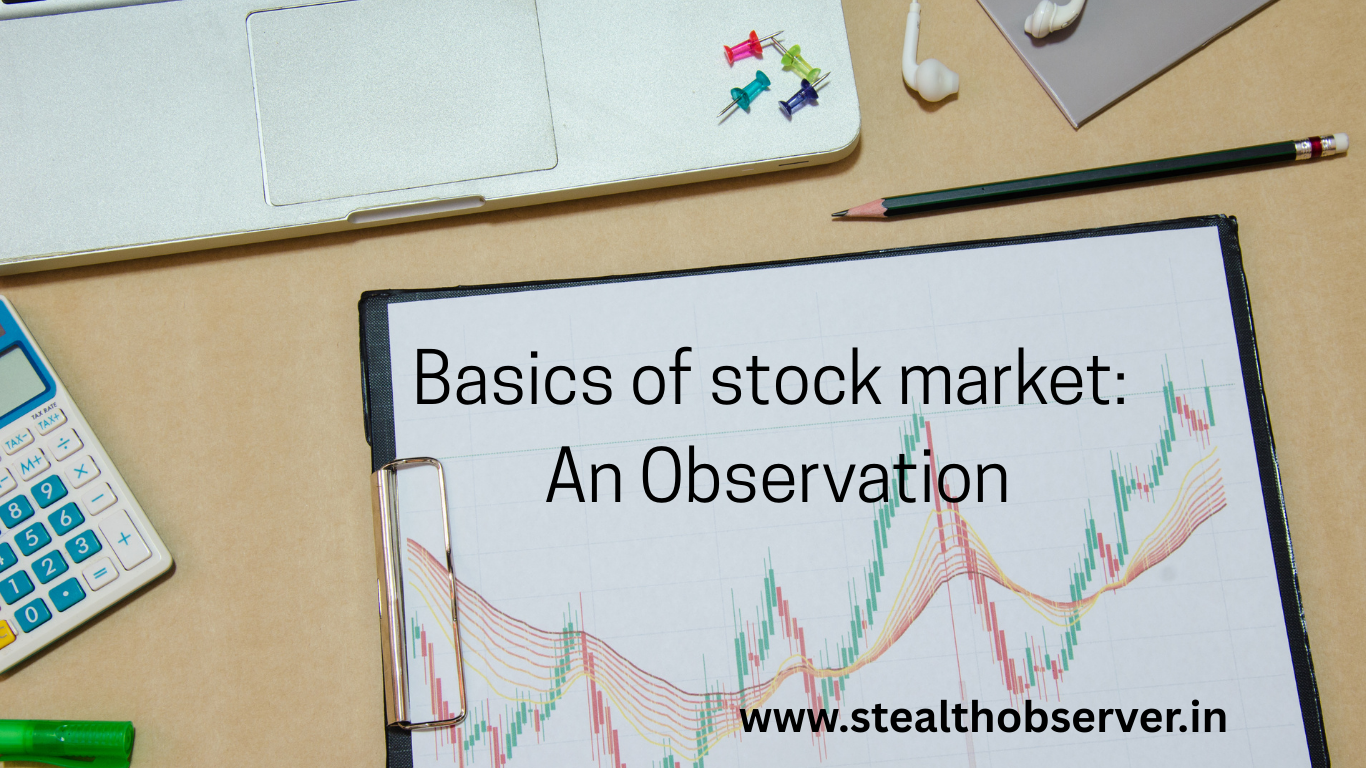
Long-term investors talk about intrinsic value and earnings growth. Traders speak of momentum and breakout levels. One observes balance sheets; the other watches candlestick formations.
It is interesting how the same asset can also be viewed through entirely different lenses.
From the outside, the stock market looks unified. From within, it feels like overlapping subcultures.
The basics of the stock market do not dictate a single style. They provide the platform; behaviour defines the approach.
Information: The Fuel of Market Movement
Another foundational element within the basics of the stock market is information.
Corporate announcements, economic data, policy decisions, and global events—all feed into price movements.
But information does not flow evenly. Some interpret it quickly. Others react later. Social media accelerates opinion. Financial news channels compress complexity into headlines.
The speed of information sometimes appears to outpace reflection.
There are moments when a single rumour causes temporary volatility. Later, clarity emerges. The cycle repeats.
I’ve noticed how the market rarely stays still at one point for long. Even calm days contain micro-movements. It is a continuous process of interpretation.
Perhaps the basics of the stock market include this rhythm—information arriving, being processed, and being reflected in price.
Notes from the Observer
- The basics of the stock market are simple in structure but layered in emotion.
- Ownership in digital form changes how people relate to companies.
- Price often behaves like a narrative meter rather than a fixed judgement.
- Risk tolerance shifts with recent experience.
- Participation styles reflect personality as much as strategy.
- The system functions quietly beneath visible volatility.
These are not conclusions. Just patterns noticed over time.
Conclusion: Returning to the Basics of the Stock Market
When viewed quietly, the basics of the stock market return to a few essential ideas—ownership, price discovery, risk, information, and structured exchange systems.
Yet around these basics, human behaviour weaves its patterns.
Excitement during rallies. Silence during corrections. Debates about valuation. Stories of success. Memories of loss.
The market continues each day, indifferent to individual emotion, yet shaped by collective participation.
From a Stealth Observer’s perspective, the stock market is not just a financial mechanism. It is a social space where belief, capital, and time intersect.
And the basics remain constant, even as interpretations change.
The observation continues.
Disclaimer:
This article reflects personal observations and general reflections on the basics of the stock market. It is written for informational and contemplative purposes only. It does not constitute financial advice, investment recommendations, or any professional guidance. Financial markets involve risk, and interpretations may vary across individuals and situations.